What's in it?
Search Entire CPID Database
Enter Products, Manufacturers, Chemicals, Product Categories and Product Types
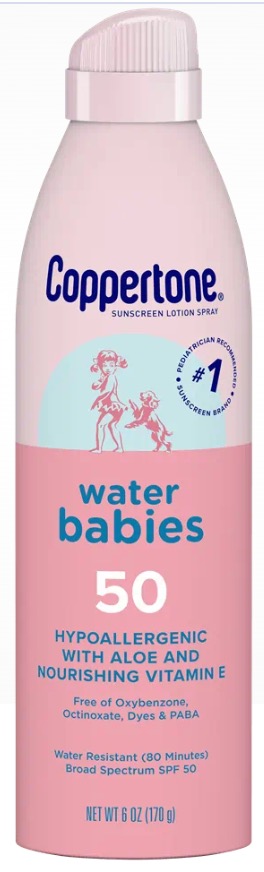 |
Coppertone Water Babies SPF 50 Hypoallergenic With Aloe Sunscreen Lotion Spray, 47959-12/04/2023
Products in this Consumer Product Information Database (CPID) are classified based on their composition:
Substances: single chemicals
Preparations: products which contain chemicals that can be easily separated during normal use
Articles: products or product assemblies that do not contain chemicals that can be separated out from the product or assembly under normal or advertised use.
Classification: Preparation
Indicates country where product is sold.
Market: US/CanadaPurpose of product.
Usage: Sunscreen for babiesStructure such as solid, liquid, aerosol etc.
Form: aerosolDate when validity of Material Safety Data Sheet (MSDS) or Safety Data Sheet (SDS) was last verified.
Date verified: April 23, 20263 Stamford Plaza, 15th Floor 301 Tresser Blvd.
Stamford CT 06901
-
Chemical Composition/Ingredients
The GHS is an acronym for The Globally Harmonized System of Classification and Labelling of Chemicals. The GHS is a system for standardizing and harmonizing the classification and labelling of chemicals. Chemicals are associated with codes that define their health, physical and environmental hazards.This universal hazard communication system was developed to ensure that employers, employees and consumers are provided with adequate, practical, reliable and comprehensible information on the hazards of chemicals, so that they can take effective preventive and protective measure for their own health and safety.
Advanced
The GHS classifications for chemicals associated with products in this database may be viewed by selecting the "Advanced" button on the Chemical Ingredients tables. Since this is a work in progress, GHS classifications may not be shown for all chemical ingredients.-
Primary Chemical Name is the standard name assigned to a chemical substance.
ChemicalChemical Abstracts Service Registry Number is a unique identifier for a chemical and its synonyms. CAS numbers identify the chemical, but not its concentration or specific mixture. CAS Registry Numbers are assigned by the Chemical Abstracts Service, a division of the American Chemical Society. For more information: www.cas.org
CAS No./ID
We have assigned "ID numbers" (with 6 leading zeros or nines, e.g., 000000-xx-x , 888888-xx-x) or 999999-xx-x) for blends and chemicals that do not have CAS numbers.Percent of chemical in preparation.
% Conc.Purpose served by this chemical
FunctionChemical of Concern (CoC)
Chemical of Concern(CoC)Avobenzone 070356-09-1 3.0 Active Ingredient No Homosalate 000118-56-9 9.0 Active Ingredient No Octisalate 000118-60-5 4.5 Active Ingredient No Octocrylene 006197-30-4 9.0 Active Ingredient No Water 007732-18-5 -- -- No Dimethyl ether 000115-10-6 -- -- No Aloe Barbadensis leaf juice 094349-62-9 -- -- No Alkyl (C12-15) benzoate 068411-27-8 -- -- No Neopentyl Glycol Diheptanoate 068855-18-5 -- -- No Butylene glycol 000107-88-0 -- -- No Styrene/acrylates copolymer 999999-58-2 -- -- No Vp/Eicosene Copolymer 028211-18-9 -- -- No 1,2-Hexanediol 006920-22-5 -- -- No Hydroxyacetophenone 000099-93-4 -- -- No Fragrance(s)/perfume(s) 000000-00-1 -- -- No Tocopherol 000059-02-9 -- -- No Acrylates/C10-30 Alkyl Acrylate Crosspolymer 176429-87-1 -- -- No Potassium hydroxide 001310-58-3 -- -- No Disodium EDTA 000139-33-3 -- -- No -
Health Effects Information
Ingredients and Health Effects Information are taken from the manufacturer's product label and/or the Safety Data Sheet (SDS). Products are not tested and manufacturer's information presented here is not evaluated by DeLima Associates.
View Safety Data Sheet(SDS) Date that the Safety Data Sheet (SDS) was issued by manufacturer of a specific product.
SDS DATE :December 04, 2023 -
Warnings
Hazard Statements
Warning. Flammable aerosol. Contains gas under pressure, may explode if heated.
Precautionary statements
General
None.
Prevention
Keep away from heat/sparks/open flames/hot surfaces. No smoking. Do not spray on an open flame or other ignition source. Pressurized container: Do not pierce or burn, even after use.
Response
If in eyes: Rinse cautiously with water for several minutes. Remove contact lenses, if present and easy to do. Continue rinsing. If eye irritation persists: Get medical advice/attention.
If inhaled: If breathing is difficult, remove person to fresh air and keep comfortable for breathing. If experiencing respiratory symptoms: Call a doctor or poison control center.
Storage
Protect from sunlight. Do not expose to temperatures exceeding 50 deg. C/122 deg. F.
Disposal
None. -
Acute health effects
From SDS:
Hazards Identification
Emergency Overview
Warning. Flammable aerosol. Contains gas under pressure, may explode if heated.
Potential Health Effects
Eye Contact: No data available.
Skin Contact: No data available.
Inhalation: No data available.
Ingestion: No data available. -
Chronic health effects
From SDS:
No information. -
Carcinogenicity
IARC: No component of this product present at levels greater than or equal to 0.1% is identified as probable, possible or confirmed human carcinogen by IARC.OSHA: No component of this product present at levels greater than or equal to 0.1% is on OSHA’s list of regulated carcinogens.NTP: No component of this product present at levels greater than or equal to 0.1% is identified as a known or anticipated carcinogen by NTP -
Handling information
Avoid formation of aerosol. Use with local exhaust ventilation. No special protective measures against fire required. -
Disposal information
If discarded in its purchased form, this product would not be a hazardous waste either by listing or by characteristic. -
California Prop. 65 Warning
This product does not contain any chemicals known to State of California to cause cancer, birth defects, or any other reproductive harm.
-
First Aid
Eye Contact: Flush eyes with water as a precaution.Skin Contact: If skin irritation persists, call a physician.Inhalation: Not an expected entry route.Ingestion: In case of accidental ingestion, contact your regional poison center or physician immediately.
-

 UN Global Harmonization Classification


