What's in it?
Search Entire CPID Database
Enter Products, Manufacturers, Chemicals, Product Categories and Product Types
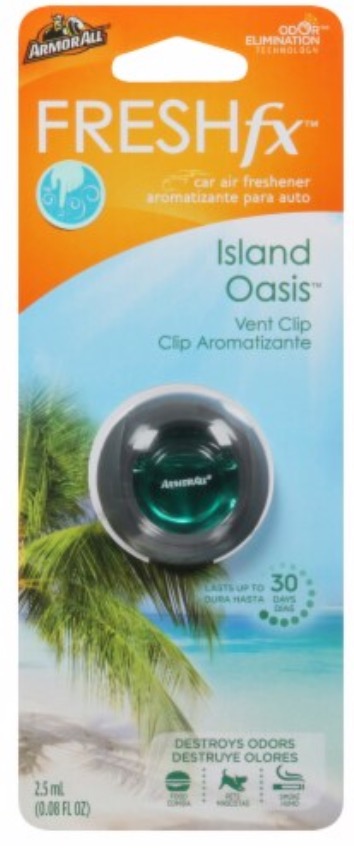 |
Armor All FreshFx Car Air Freshener, Vent Clip, Island Oasis-09/18/2025
Products in this Consumer Product Information Database (CPID) are classified based on their composition:
Substances: single chemicals
Preparations: products which contain chemicals that can be easily separated during normal use
Articles: products or product assemblies that do not contain chemicals that can be separated out from the product or assembly under normal or advertised use.
Classification: Preparation
Indicates country where product is sold.
Market: US/CanadaPurpose of product.
Usage: Air freshenerStructure such as solid, liquid, aerosol etc.
Form: liquidDate when validity of Material Safety Data Sheet (MSDS) or Safety Data Sheet (SDS) was last verified.
Date verified: February 12, 202325225 Detroit Road
Westlake OH 44145
-
Chemical Composition/Ingredients
The GHS is an acronym for The Globally Harmonized System of Classification and Labelling of Chemicals. The GHS is a system for standardizing and harmonizing the classification and labelling of chemicals. Chemicals are associated with codes that define their health, physical and environmental hazards.This universal hazard communication system was developed to ensure that employers, employees and consumers are provided with adequate, practical, reliable and comprehensible information on the hazards of chemicals, so that they can take effective preventive and protective measure for their own health and safety.
Advanced
The GHS classifications for chemicals associated with products in this database may be viewed by selecting the "Advanced" button on the Chemical Ingredients tables. Since this is a work in progress, GHS classifications may not be shown for all chemical ingredients.-
Primary Chemical Name is the standard name assigned to a chemical substance.
ChemicalChemical Abstracts Service Registry Number is a unique identifier for a chemical and its synonyms. CAS numbers identify the chemical, but not its concentration or specific mixture. CAS Registry Numbers are assigned by the Chemical Abstracts Service, a division of the American Chemical Society. For more information: www.cas.org
CAS No./ID
We have assigned "ID numbers" (with 6 leading zeros or nines, e.g., 000000-xx-x , 888888-xx-x) or 999999-xx-x) for blends and chemicals that do not have CAS numbers.Percent of chemical in preparation.
% Conc.Purpose served by this chemical
FunctionChemical of Concern (CoC)
Chemical of Concern(CoC)Hexyl Cinnamal 000101-86-0 -- Fragrance Yes  CoC List
Cyclohexanol, 2-(1,1-dimethylethyl)-, 1-acetate, (1R,2R)-rel- 020298-69-5 -- Fragrance No 2-T-Butylcyclohexyl Acetate 000088-41-5 -- Fragrance No 2(3H)-Furanone, 5-heptyldihydro- 000104-67-6 -- Fragrance No Butylphenyl Methylpropional 000080-54-6 -- Fragrance Yes CoC List
Linalool 000078-70-6 -- Fragrance Yes CoC List
2,6-Dimethyl-7-Octen-2-Ol 018479-58-8 -- Fragrance No Menthyl Acetate 000089-48-5 -- Fragrance No Citrus Sinensis (Orange) Fruit 008028-48-6 -- Fragrance No d-Limonene 005989-27-5 -- Fragrance Yes CoC List
Benzyl Salicylate 000118-58-1 -- Fragrance Yes CoC List
2-Ethyl-4-(2,2,3-trimethylcyclopent-3-en-1-yl)but-2-en-1-ol, (E)- 106185-75-5 -- Fragrance No Ethyl Trimethylcyclopentene Butenol 028219-61-6 -- Fragrance No Dimethyl Phenethyl Butyrate 010094-34-5 -- Fragrance No Allyl Heptanoate 000142-19-8 -- Fragrance No Hexahydro-Methanoindenyl Propionate 068912-13-0 -- Fragrance No Tricyclodecenyl Propionate 017511-60-3 -- Fragrance No alpha-Terpineol 000098-55-5 -- Fragrance No alpha,alpha-Dimethylbenzeneethyl acetate 000151-05-3 -- Fragrance No Methylenedioxyphenyl Methylpropanal 001205-17-0 -- Fragrance No Citronellol 000106-22-9 -- Fragrance Yes CoC List
3-(O-Ethylphenyl)-2,2-Dimethylpropionaldehyde 067634-14-4 -- Fragrance No Allyl Caproate 000123-68-2 -- Fragrance No Ethyl Methylphenylglycidate 000077-83-8 -- Fragrance No 2,6,10-Trimethylundec-9-enal 000141-13-9 -- Fragrance No Cis-3-Hexenyl Methyl Carbonate 067633-96-9 -- Fragrance No Ethyl Linalool 010339-55-6 -- Fragrance No 2,4-Dimethyl-3-Cyclohexene Carboxaldehyde 068039-49-6 -- Fragrance No 4-Methyl-3-Decen-5-Ol 081782-77-6 -- Fragrance No Ethyl 2,2-Dimethylhydrocinnamal 067634-15-5 -- Fragrance No (E)-1-(2,6,6-Trimethyl-1-cyclohexen-1-yl)-2-buten-1-one 023726-91-2 -- Fragrance No Allyl Cyclohexylpropionate 002705-87-5 -- Fragrance No Geraniol 000106-24-1 -- Fragrance Yes CoC List
Hexyl Salicylate 006259-76-3 -- Fragrance No alpha-Isomethyl ionone 000127-51-5 -- Fragrance Yes CoC List
Coumarin 000091-64-5 -- Fragrance Yes CoC List
Isoamyl acetate 000123-92-2 -- Fragrance No Citral 005392-40-5 -- Fragrance Yes CoC List
Vanillin 000121-33-5 -- Fragrance No Heliotropine 000120-57-0 -- Fragrance No Hydroxycitronellal 000107-75-5 -- Fragrance Yes CoC List
Acetylcedrene 032388-55-9 -- Fragrance No Cinnamyl Alcohol 000104-54-1 -- Fragrance Yes CoC List
Benzaldehyde 000100-52-7 -- Fragrance No Rose Ketone-4 023696-85-7 -- Fragrance No Alpha-Pinenes 000080-56-8 -- Fragrance No -
Health Effects Information
Ingredients and Health Effects Information are taken from the manufacturer's product label and/or the Safety Data Sheet (SDS). Products are not tested and manufacturer's information presented here is not evaluated by DeLima Associates.
View Safety Data Sheet(SDS) Date that the Safety Data Sheet (SDS) was issued by manufacturer of a specific product.
SDS DATE :September 18, 2025 Health Flammability Reactivity HMIS is the Hazardous Materials Identification System developed by the American Coatings Association and indicates the levels (“1” to “4”) of Health Hazard, Flammability Hazard and Physical Hazard associated with a specific product.
HMIS RATING2* 2 0 -
Warnings
Hazard Statements
Danger. Combustible liquid. Causes skin irritation. May cause an allergic skin reaction. Causes serious eye irritation. May damage fertility or the unborn child.
Precautionary Statements
General
Do not handle until all safety precautions have been read and understood.
Prevention
Keep away from heat/sparks/open flames/hot surfaces. No smoking. Avoid breathing dust/fume/gas/mist/vapors/spray. Contaminated work clothing must not be allowed out of the workplace. Wear protective gloves/eye protection/face protection.
Response
If on skin: Wash with plenty of water. If skin irritation or rash occurs: Get medical advice/attention. Take off contaminated clothing and wash before reuse. Wash contaminated clothing before reuse.
If in eyes: Rinse cautiously with water for several minutes. Remove contact lenses, if present and easy to do. Continue rinsing. If eye irritation persists: Get medical advice/attention.
If exposed or concerned: Get medical advice/attention.
In case of fire: Use sand, carbon dioxide or powder extinguisher to extinguish.
Storage
Store in a well-ventilated place. Keep cool. Store locked up.
Disposal
Dispose of contents/container in accordance with national regulations. -
Acute health effects
From SDS:
Hazards Identification
Emergency Overview
Danger. Combustible liquid. Causes skin irritation. May cause an allergic skin reaction. Causes serious eye irritation. May damage fertility or the unborn child.
Potential Health Effects
Eye Contact: Based on available data, the classification criteria are not met.
Skin Contact: Causes serious eye irritation.
Inhalation: May be harmful if inhaled.
Ingestion: No information. -
Chronic health effects
From SDS:
None currently known. -
Carcinogenicity
Based on available data, the classification criteria are not met.
-
Handling information
Use local and general ventilation. Avoidance of ignition sources. Keep away from sources of ignition. No smoking. Take precautionary measures against static discharge. Use only in well-ventilated areas. Due to danger of explosion, prevent leakage of vapours into cellars, flues and ditches. Ground/bond container and receiving equipment. Use explosion-proof electrical/ventilating/lighting/equipment. Use only non-sparking tools. Places which are not ventilated, e.g. unventilated below ground level areas such as trenches, conduits and shafts, are particularly prone to the presence of flammable substances or mixtures. Vapors are heavier than air, spread along floors and form explosive mixtures with air. Vapors may form explosive mixtures with air. Wash hands after use. Do not eat, drink and smoke in work areas. Remove contaminated clothing and protective equipment before entering eating areas. Never keep food or drink in the vicinity of chemicals. Never place chemicals in containers that are normally used for food or drink. Keep away from food, drink and animal feedingstuffs. Keep container tightly closed and in a well-ventilated place. -
Disposal information
Do not empty into drains. Avoid release to the environment. Completely emptied packages can be recycled. Handle contaminated packages in the same way as the substance itself.
-
First Aid
Eye Contact: Remove contact lenses, if present and easy to do. Continue rinsing. Irrigate copiously with clean, fresh water for at least 10 minutes, holding the eyelids apart.Skin Contact: Wash with plenty of soap and water.Inhalation: If breathing is irregular or stopped, immediately seek medical assistance and start first aid actions. Provide fresh air.Ingestion: Rinse mouth with water (only if the person is conscious). Do NOT induce vomiting.General: Do not leave affected person unattended. Remove victim out of the danger area. Keep affected person warm, still and covered. Take off immediately all contaminated clothing. In all cases of doubt, or when symptoms persist, seek medical advice. In case of unconsciousness place person in the recovery position. Never give anything by mouth.
-

 UN Global Harmonization Classification


